


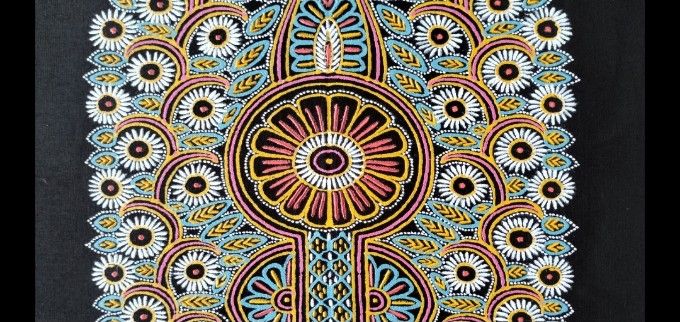
There are a number of rare as well as remarkable crafts that are present in India. Among these, Rogan art stands out as one of the most unique, delicate, and visually captivating art forms because this was born from the soil of Gujarat and it has been 400 years since this art form existed. It is done not with a brush but with a thin metal stick and the colours used are made from castor oil which gives the art its distinctive name, Rogan, which means art that comes from oil. In a world where digital prints and machine-made designs are very common, this art survives as a testament to the devotion of artisans and the patience that they had when they were creating extraordinary pieces. It is not just a painting technique, it is a language of intricate patterns, mythological stories, and centuries-old skill that has been passed down through generations.
History
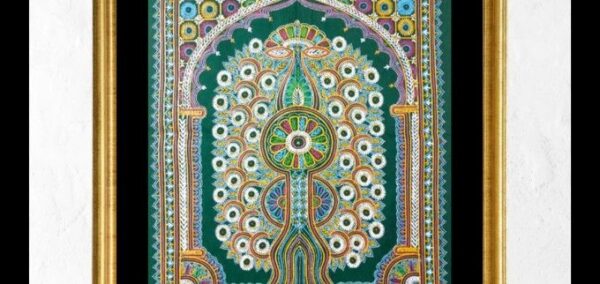
Rogan art traces its origins back to Persia from where it travelled to India a number of centuries ago. It found its home in the Kutch region, especially in villages such as Mirona where a handful of families continue this craft with a lot of dedication. Historically, these paintings were created to decorate the bridal clothing as well as special fabrics that were used often in local weddings. Women used to embroider their saris and Rogan painted fabrics were a prestigious and decorative piece that showcased prosperity as well as cultural pride. When machine-made textiles became more common, the demand for Rogan art reduced drastically yet the artisans of Kutch protected the craft as much as they could and turned it into one of India’s rarest handmade traditions. Today, only a few families continue to preserve and teach this ancient craft.
Method and Difficulty
The most beautiful aspect of this art is its technique. It is not conventional in nature. The artists have to prepare a thick paste that is almost jelly-like by boiling the castor oil for hours until it becomes extremely dense as well as sticky. Then the paste is mixed with all the natural pigments to create bright colours like red, yellow, blue, green, black and orange. The artist takes a small amount of this coloured Rogan paste and rolls it into thread-like consistency and this requires a lot of effort because they do it with a very thin metal rod. Instead of applying the paint directly, the artisan suspends the paste in air, guiding it with precision so that it gently foils onto the fabric as delicate lines. This technique requires tremendous skill, steady hands and a ton of practice. A single misplaced drop can spoil the look of the whole fabric. The painter’s hands should never touch the cloth. They create motifs from above using a lot of movement, control and instinct. It is very difficult and requires a lot of practice.
Uniqueness
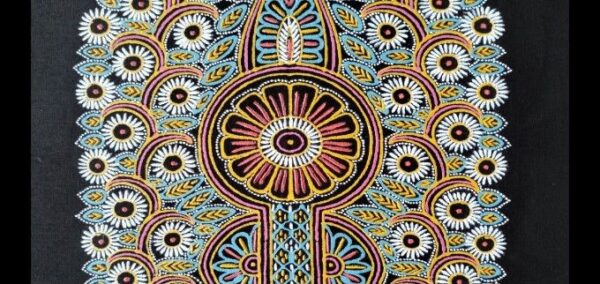
Watching a Rogan artist work is like watching music take visual form because it is extremely rhythmic as well as mesmerizing in nature. There is a mirror image technique which is often used in Rogan art. The artisan first paints half of the design on one side of the fabric. Then while the paste is still wet, the cloth is folded and it transfers the design onto the other half extremely perfectly which creates geometrical as well as symmetric patterns on both sides which is a hallmark of authentic Rogan craftsmanship. Once the basic framework is completed, the artist adds more detailing by hand and it increases the beauty of the design.
Author
Shreeja Mukherjee
Explore all articles: Click here