


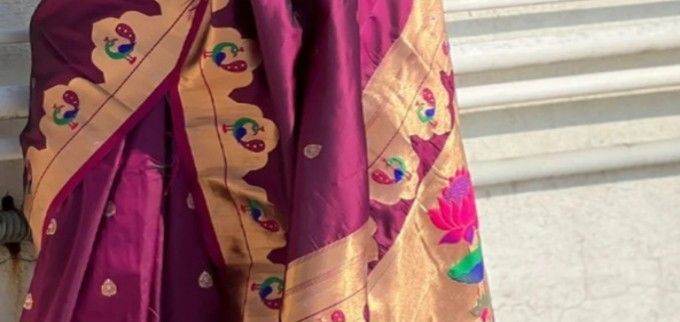
There are vast and vivid textile traditions in India, and there are hardly any garments which have the same reverence as well as respect as the Paithani sari. It is described as the queen of silk saris. It is not merely a garment, but in fact it is like a legacy, an heirloom which has been passed down from queens from generation to generation, and within this sari, there is a story, a story that is full of royalty, devotion, and the cultural history of our great country. It has shimmering silk motifs that are extremely distinctive in nature and hand-woven brilliance which makes it one of the most treasured textiles in the world and a symbol of beauty as well as grace for all Indian women.
Origin
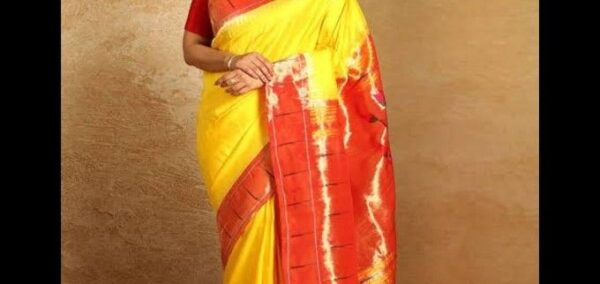
The origin of this sari is traced back over 2,000 years to the ancient city of Pethan. This city was located on the banks of Godavari River in present-day Maharashtra. Under the dynasty, Pethan emerged as a hub of exquisite textile production. It had luxurious garments which were exported to different countries like Rome, Greece, and China, and it marked the early evidence of India’s global influence as well as excellence in handloom craft. Over centuries, the art of Pethani weaving flourished under the patronage of the Peshwas, the Mughals, and several regional rulers. The Mughals admired the richness of the Pethani motifs because of its beauty and the time it took to create one sari. In fact, Aurangzeb is also known to favour these fabrics for gifting it to other people, and the Peshwa queens adorned themselves in saris that took years to weave. It was a hard job to weave it, but the result was extremely excellent. Even today, a fine sari remains a cherished part of the Maharashtrian bridal trousseau.
Heritage
Owning a Pethani is not only about fashion, it is about respecting the legacy that our country holds. A Pethani sari is hand-woven, and that is why it is so classy in nature. The weaving technique requires a lot of labour, it can be only done by someone who is very precise in their craft, and it requires a tonne of patience. The most striking element of this sari is the work which has been done using gold thread or fine thread and silver-coated copper. The borders are created with a tapestry kind of a technique where each motif is woven individually, and it is not embroidered or printed. That means the design appears identically on both sides, a hallmark of authentic Pethani craftsmanship. An original Pethani sari will never only be printed on one side, it is always printed on both the sides, and a single sari can take anywhere from one month to three years to complete, and that depends on the precision as well as the intricacy of the design. The loom used is a simple pit loom, but the weaver’s skill transforms it into a tool of extraordinary artistry.
What makes these saris extraordinary?
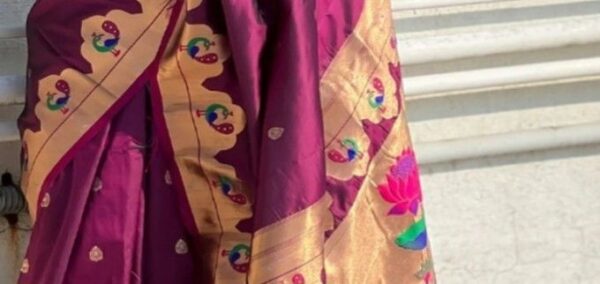
These saris are renowned for their vibrant hues, traditionally colours were derived from natural dyes like flowers, minerals and plant extracts. However, today, both natural and chemical dyes can be used due to the advancement of technology, however the charm of the sari remains unmatched. Although nowadays there has been a great rise of machine-made textiles, weaving a pehtani sari survives because of its cultural value as well as the dedication of artisans. In places like Sholapur as well as Pehtan, many designers have re-inspired pehtani motifs in lehengas, dupattas, blouses, and even dresses. There are many Bollywood actresses like Madhuri Dixit or Vidya Balan who have worn these saris at cultural events promoting the craft to a larger audience. This sari remains a favourite during Maharashtrian weddings and all kinds of festivities.
Author
Shreeja Mukherjee
Explore all articles: Click here