


Introduction
Kutch embroidery of Gujarat is like a living canvas of colour, craft, and culture because India’s artistic legacy is a vast tapestry that is woven with a lot of textures as well as colours. Kutch embroidery stands out as one of the most colourful as well as intricate forms of needlework. It is not just an art, it is a living language, simply a way for women of Gujarat to narrate stories of how their communities worked, how they lived in their surroundings, and how these needlework showcase their identity.
Origin
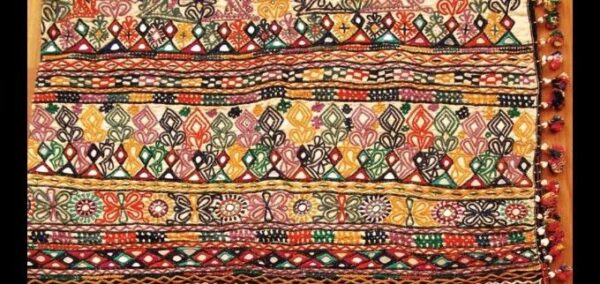
Kutch was a district in western Gujarat and it is known for its stark landscapes as well as the desert winds. Historically, the various tribes that were living in this region were the Rabari, the Ahis, the Sodha, the Jat, and they practiced this embroidery not simply as a hobby but as a very important and essential part of their culture. Even young girls who were as young as 6 years old began learning this craft and by the time they reached their marriageable age, they would have embroidered an entire trousseau for themselves which they would wear after their marriage. This tradition was not merely decorative, it represented the cultural pride of the state. Every motive, every colour choice that was created and every stitch had a special significance to it. For example, Rabari embroidery is bold and dramatic reflecting the spirit of the tribes while Muthwa embroidery is delicate and fine which reflects the microscopic lace work.
Diversity
The diversity within Kutch embroidery is a true reflection of how multicultural Gujarat’s roots are. What makes Kutch embroidery extraordinary is its use of a wide variety of stitches each adding depth, dimension and personality to the fabric. Some of the iconic stitches are the herringbone stitch which is used to fill bold patterns and create textured surfaces. There is a chain stitch which helps in building fluid curved designs which give a lot of elegance to the clothing. The satin stitch is very smooth and it creates a shiny patch of colour. The mirror work is said to put bad spirits away. The famous Saharan stitch creates a raised effect and it is widely used in a lot of Kutch embroidery. These stitches come together to form a great number of architectural motifs as well as floral patterns, animals and geometric shapes as well as mythological symbols.
The Hidden Symbolisms
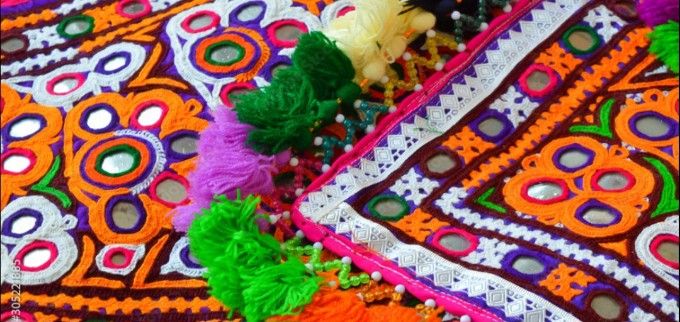
Each piece of embroidery becomes a canvas of creativity which has been entirely shaped by the imagination of the artisan. The importance of the mirror work is that one of the most captivating features of Kutch embroidery is the shisha work or the mirror embroidery. Traditionally, women believed that mirrors on the clothing would ward off evil spirits by reflecting them away. Over time, this belief evolved into a distinct aesthetic style which shaped these garments. These mirrors were often small round square and diamond shaped and they were embedded properly into the garment using the most secure stitches turning the cloth into a shimmering artwork. In sunny regions like Kutch, the dazzling effect of mirror work has also become symbolic of festivity, happiness as well as prosperity. Today, this element is closely associated not only with Kutch embroidery but with Gujarati craft as a whole. These motives are also inspired by the life, landscape and surroundings of Gujarat.
Inspiration
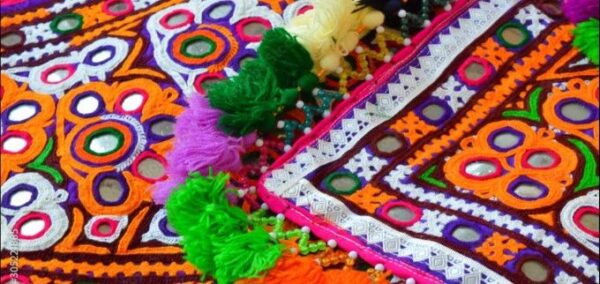
For example, the camel’s peacocks are symbols of beauty as well as the desert culture and heritage. The elephants often represent strength as well as royalty that is a prevalent part of the state. The floral vines and lotuses showcase the prosperity and purity within the medians of the state. The temple arches which showcase the region’s architectural legacy and the geometric arrangements showcase the mathematical precision present in the people of the state. Colour is central to Kutch embroidery, traditionally artisans used vegetable dyes that were taken from plants and minerals which created extremely rich earthy tones like maroon, black, yellow and deep green. Today, with readily available synthetic dyes, the colour palette has expanded a lot because now artisans also use bright pinks, oranges and blues that are seen in Rabri and Ahir work. This explosion of colour is similar to Kutch embroidery and has always been used even in vegetable dyes.
Author
Shreeja Mukherjee
Explore all articles: Click here