


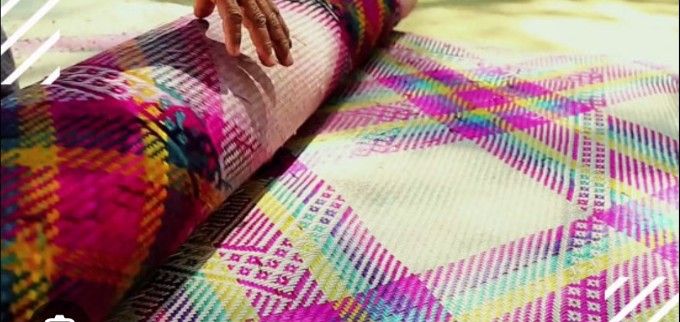
India is a land of diversity and there are centuries of craftsmanship that have been rooted in the idea of Seetalpati mat weaving of Tripura. It is among India’s many remarkable handicrafts and it is very well known for its utility, beauty, as well as its cultural significance. The word Seetalpati literally means a cool mat and true to its name, these mats have the ability to naturally stay very cool even in the intense heat of north-eastern summers. It is not a household item. It is a mat which showcases the artistic excellence, patience, and dedication of the people of Tripura. It is formed from an age-old technique which has been practiced by communities in north Tripura, especially in the districts of Kailashahar, Dharmanagar, and Panisagar.
The Primary Material
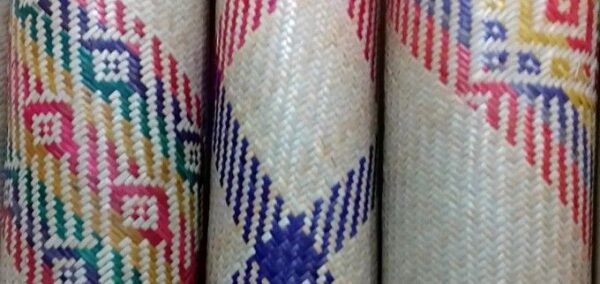
The craft relies on a unique raw material that is the Murta cane, which is a plant that is scientifically known as dichotomous in nature. This plant grows a lot in the wetlands and the riverbanks of Tripura, which makes it abundant in nature in that state. The good thing about this plant is that its outer layer is peeled away and the soft, glossy inner layer is cut into fine strips that are smooth, flexible, and cool to the touch. These strips are then woven together by skilled artisans and it creates the most beautiful mats that are very functional and due to these qualities, these mats hold a significant place in the daily life as well as the cultural significances of Tripura. Seetalpati weaving has been practiced for centuries and it has been passed down from families. Usually, the women played the central role in weaving the mat. Young girls watched their mothers and sisters when they worked and learned the craft over time. By adulthood, they had expertly mastered the skill of cutting, polishing, and weaving Murta cane into the most intricate designs. The craft has always been more than just a household activity.
Cultural Significance
Earlier also, the quality of the Seetalpati a family owned was a sign of its social status. Finely woven mats were very good possessions and even given as a wedding gift or used during important household rituals. Even today, they remain an essential part of Tripura’s cultural identity. The process of making this mat is extremely labour requiring and demands a very keen eye for detail. Firstly, the person has to harvest the Murta plant which is then soaked in water to make the outer layers extremely easy to peel. The artisans have to be very careful when they remove the hard bank as it reveals the smooth inner core. This core is sliced into long thin strips that are then repeatedly polished to achieve a very natural shine. This gives a beautiful look to the mat when it is created.
The Tedious Weaving Process
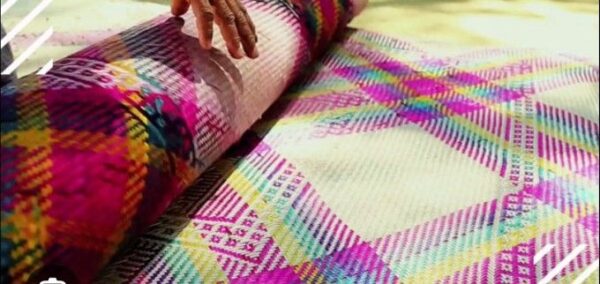
After the strips have been meticulously ready, the actual weaving process begins. The artisans have to sit cross-legged on the ground with the cane strips and they have to lay it before them. They weave everything by hand as they interlace the strips in a variety of patterns which depend on the type of mat that is being produced. A simple mat may take a day to complete while more intricate designs can take several days or even weeks to create. Some artisans incorporate naturally dyed strips to create very colourful borders as well as geometric designs. The final product is a mat that is very cool to sit in during the summer. Now there are different types of Sitalpati mats. Firstly, we have the regular Sitalpati mat which is a simple mat that is woven with very plain strips and these are generally used for various activities like sitting or sleeping or even everyday household purposes. Their defining feature is their natural coolness. Then there is a Nakshi mat which is of the very premium variety and it is known for its intricacy when it comes to the designs and craftsmanship. These mats even have motifs that have been inspired by nature like flowers, leaves, vines and geometric patterns.
These mats are very fine, smooth and they are highly valued as heritage items. In fact, Nakshi mat of Tripola received a geographical indication tag highlighting its cultural and artistic importance. Now, earlier it was mentioned that Sitalpati mats have a lot of cultural value. This is because they are often used during festivals and social gatherings as well as traditional ceremonies. In many tribal communities, when you offer a Sitalpati mat to a guest, it is considered that you have a lot of respect and love for the guest. Even during weddings, these mats are included in the bride’s clothes as symbols of prosperity and abundance.
Author
Shreeja Mukherjee